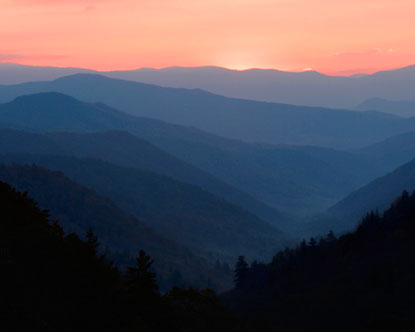
The beauty of spring in the Appalachian Mountains inspired a noted American composer, Aaron Copland, to create his melodic symphony, Appalachian Spring, thereby the title to this article.
Spring arrives softly, sometimes even before the last snow has melted. The first indication is the crimson new growth on Maple trees, standing out in vivid contrast to the muted grays and browns of winter-bare branches, saying “Look at me, I’m the first herald of the new season.” A few weeks later, white begins appearing through the forests as the Silver Bells and Serviceberry (locally called “Sarviceberry”) trees of medium height display their blossoms. Violets carpet the woodland floors in hues from white to deep violet and yellow, displayed against green leaves, some heart-shaped and others like a bird’s foot, after which they were named. Dandelions spring forth, generally unwanted, even though their tender new leaves make tasty salads and steamed greens and their yellow blossoms are like splashes of golden sunlight in a circlet of green leaves. Nestled in shady areas are the highly protected and rare Shortia plants, with their white star-shaped blooms, along with Galax, prized for its shiny leaves, with spikes of small white flowers.
Soon afterwards, Dogwood trees make a dramatic statement throughout the forests with their white “flowers”, even though the white part is a sepal and the real flower is a cluster of tiny yellow bracts in the center, hardly noticeable. Along with these are the Redbud trees, often called “Judas Trees” from lore that casts them as the tree from which the traitorous disciple hanged himself. As with Dogwoods, they are small-sized trees with clusters of fuchsia-colored blossoms. Wild plum adds to the white-blossomed complement of small trees.
Interspersed with nature’s display are the non-native flowering trees including Flowering Pear, an extremely showy white-blossomed tree; Flowering Peach, Plum and Cherry, all quite spectacular and colorful, and Wisteria, a vine with its panacles of lavender blooms. Daffodils, narcissus, tulips, crocuses, irises, clematis and a myriad of blooming bulbs and flowers make their appearance and transform even the humblest abode into a thing of beauty.
Several weeks later, Flame Azalea, a bushy plant sometimes called “Honeysuckle” makes its triumphant entry with fragrant blooms from deep coral to white, along with its relative, the Pinkster”, whose name describes the color of its blossoms. Not to be outdone is the showy Catawba Rhododendron shrub, denizen of the higher mountain ridges, with large clusters of fuchsia-colored blooms that elicit oohs and aahs from viewers. Along with them are the Mountain Ash trees with their large clusters of white blooms that presage their impressive fall showing of bright red berries. Terrestrial orchids, such as pink and white Lady Slipper, Showy Orchis, Fringed Orchis and others are there for the seekers of nature’s beauty.
Another several weeks pass and Mountain Laurel sends forth its clusters of blossoms with colors ranging from soft to deep pinks. The banks of mountain streams and rivers are festooned with these shrubs, and their reflection in the water enhances the vision. Then comes the Rhododendron of the mid-elevations, a shrub with great shiny deep green leaves and huge bracts of flowers with hues of pink from nearly white to medium. This is accompanied by the Punk Tatum Rhododendron, a smaller cousin with equally delightful bracts of lavender-pink flowers. And not to be overlooked are the brambles of honeysuckle, an invasive vine that has exceptionally fragrant blossoms which youngsters and adults alike pluck and sip the nectar therefrom.
Many varieties of cultivated rhododendron are planted throughout the area. Blooms range from red, pink, purple and fucsia, to yellow, coral and white, and the plant sizes are from miniature to full-size. All are spectacular.
The Story of Appalachian Spring begins in early March and proceeds until early August. It’s no wonder Copland was so enchanted with this beautiful place that he was inspired to write his symphony.

