


When I entered puberty I developed boils under my left arm which I guess was nature's way of announcing that I was becoming a man. I could have developed boils in other places but I was content to have my left arm immobile for a week. I was fourteen and had to stay home from school for a few days and as luck would have it I had a typewriter ( not electric in those days) which kept my right hand occupied. I was a fanatical Dodger rooter in those days and since I had nothing else to occupy myself I typed out what I thought the finish of both major leagues would .be. The season was just starting. it was early April. I had my thoughts about each of the sixteen teams and I typed out my comments and prognosis as to where each team would finish the season. My mother, God love her, read my article and although she was hardly a baseball fan (Bach and Brahms were her love) suggested that I send the article with a a note to the sports section of The New York Post, telling my age and the fun I had writing the article. I frankly thought she was insane insisting I send the article in but I did so. A few days later my Dad whose office was in New York City was suddenly flooded with phone calls from friends, relatives and business associates wanting to know who the hell was Josef Behrens. Lo and behold the editor of the sports section read my articles and not only printed everythingi in full with my letter, gave me a byline no less, published a three column article with a headline reading "Dodger fan, 14, does experting". Needless to say, my proud father brought home as many of the New York Post he could carry and , of course, I was completely floored. After all these years it remains one of the great thrills of my life. Dad had the article framed and it sits (proudly I might add) in my closet and if you don't believe this crazy little story you are cordially invited to my home to see for yourslf that this story is true. Incidentally I picked the Yankees to win and they did; I picked the Dodgers but they lost to the Cardinals the last week of the season. Oh well, win some, lose some.
Monday, April 26, 2010
Mountain Musings By M.I. Lee
Appalachian Spring
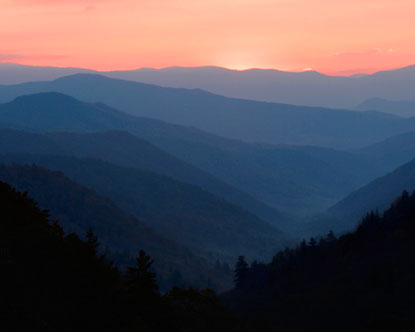
The beauty of spring in the Appalachian Mountains inspired a noted American composer, Aaron Copland, to create his melodic symphony, Appalachian Spring, thereby the title to this article.
Spring arrives softly, sometimes even before the last snow has melted. The first indication is the crimson new growth on Maple trees, standing out in vivid contrast to the muted grays and browns of winter-bare branches, saying “Look at me, I’m the first herald of the new season.” A few weeks later, white begins appearing through the forests as the Silver Bells and Serviceberry (locally called “Sarviceberry”) trees of medium height display their blossoms. Violets carpet the woodland floors in hues from white to deep violet and yellow, displayed against green leaves, some heart-shaped and others like a bird’s foot, after which they were named. Dandelions spring forth, generally unwanted, even though their tender new leaves make tasty salads and steamed greens and their yellow blossoms are like splashes of golden sunlight in a circlet of green leaves. Nestled in shady areas are the highly protected and rare Shortia plants, with their white star-shaped blooms, along with Galax, prized for its shiny leaves, with spikes of small white flowers.
Soon afterwards, Dogwood trees make a dramatic statement throughout the forests with their white “flowers”, even though the white part is a sepal and the real flower is a cluster of tiny yellow bracts in the center, hardly noticeable. Along with these are the Redbud trees, often called “Judas Trees” from lore that casts them as the tree from which the traitorous disciple hanged himself. As with Dogwoods, they are small-sized trees with clusters of fuchsia-colored blossoms. Wild plum adds to the white-blossomed complement of small trees.
Interspersed with nature’s display are the non-native flowering trees including Flowering Pear, an extremely showy white-blossomed tree; Flowering Peach, Plum and Cherry, all quite spectacular and colorful, and Wisteria, a vine with its panacles of lavender blooms. Daffodils, narcissus, tulips, crocuses, irises, clematis and a myriad of blooming bulbs and flowers make their appearance and transform even the humblest abode into a thing of beauty.
Several weeks later, Flame Azalea, a bushy plant sometimes called “Honeysuckle” makes its triumphant entry with fragrant blooms from deep coral to white, along with its relative, the Pinkster”, whose name describes the color of its blossoms. Not to be outdone is the showy Catawba Rhododendron shrub, denizen of the higher mountain ridges, with large clusters of fuchsia-colored blooms that elicit oohs and aahs from viewers. Along with them are the Mountain Ash trees with their large clusters of white blooms that presage their impressive fall showing of bright red berries. Terrestrial orchids, such as pink and white Lady Slipper, Showy Orchis, Fringed Orchis and others are there for the seekers of nature’s beauty.
Another several weeks pass and Mountain Laurel sends forth its clusters of blossoms with colors ranging from soft to deep pinks. The banks of mountain streams and rivers are festooned with these shrubs, and their reflection in the water enhances the vision. Then comes the Rhododendron of the mid-elevations, a shrub with great shiny deep green leaves and huge bracts of flowers with hues of pink from nearly white to medium. This is accompanied by the Punk Tatum Rhododendron, a smaller cousin with equally delightful bracts of lavender-pink flowers. And not to be overlooked are the brambles of honeysuckle, an invasive vine that has exceptionally fragrant blossoms which youngsters and adults alike pluck and sip the nectar therefrom.
Many varieties of cultivated rhododendron are planted throughout the area. Blooms range from red, pink, purple and fucsia, to yellow, coral and white, and the plant sizes are from miniature to full-size. All are spectacular.
The Story of Appalachian Spring begins in early March and proceeds until early August. It’s no wonder Copland was so enchanted with this beautiful place that he was inspired to write his symphony.


Monday, April 5, 2010
Mozart Didn't Play Second Base - By Joesf Behrens

Uncles and more Uncles
I was born and raised in Paterson N.J.; My mother was born and raised in Paterson N.J. This unimportant fact has absolutely no bearing on this article but I thought it might raise a few eyebrows knowing that the family settled in Paterson in 1895.This city during the depths of the depression in the 30's when I was a boy was a lovely residential community replete with parks and beautiful one family homes. I t was a wonderful place for a boy to grow up in. Which leads me to the meat and potatoes of this narrative - my mother's four brothers who, as it fortuitously turned out, were also my uncles. And what uncles they were! Having those uncles around was like living in the middle of a circus tent. They were enormously talented, all comedians (George Burns had nothing on them), all family oriented, all giving and they all loved me fiercely - bless me.. Being in the bosom of that wonderful family (and please don't think that my aunts were any different God bless them) was like living in a George S. Kaufman comedy. My eldest uncle Leo - in those days the first born always received most of the opportunities and already was a fine, concert violinist when he was sent to continue his studies in Berlin prior to World War 1. One of his letters home described a concert in Berlin with a young 12 year old boy who played the Mendelssohn Violin Concerto with the philharmonic. He stated that he never expected to hear violin playing like that again in his lifetime and was ready to trash his violin - the boy was Jascha Heifetz. . Leo , who was the "star" of the family subsequently became music director of WOR Mutual, and conducted the Newark Symphony Orchestra. And although married and as straight as a yardstick his gay routine was the best I ever saw. The second oldest was my uncle Herman aho had the distinction of not only opening the first circus in town but also its first silent movie theater. My teenage mother who couldn't read music yet played the piano for Herman in the theater. His chief claim musically was to play the first movement of the aforementioned Mendelssohn concerto with only his index finger. What a family. Herman was also incredibly funny. Then there were my marvelous, wonderful twins - Irving and Eddie who would have performed in vaudeville as twin tap dancers except for the fact that my grandfather of the old German school wouldn't allow it since it didn't portray the family image properly. Those two uncles. Eddie learned how to play violin by watching his older brother practice - he never took a lesson and wound up in the Memphis Symphony. He always bragged that he played before all the crowned heads of Europe and some very peculiar people in Pennsylvania. Irving on the other hand couldn't play the violin the normal way but he played it like a cello between his legs. He was so adept that he headed a program on the radio in Memphis as the "unknown violinist" And I must tell you that he played the hell out of that "cello fiddle".
The benevolent influence these extraordinary uncles had on my life was prophetic. At the age of two I was fully immersed in classical music. Watching my uncles tap dance and perform musically, seeing and hearing Leo (my idol) play a phenomenal violin (in spite of Heifetz!), enjoy playing the violin in school with my mother at the piano. My four uncles didn't belong in a normal home - people should have paid to see them in a theater. They're all gone now and at the age of 82 I cherish those wonderful memories.
Sunday, April 4, 2010
Food for Haitians
Mountain Musings
This morning my husband and I had a wonderful opportunity of participating as one of many volunteers in the assembling of fifty thousand packets of food mix destined for Haiti. The event was sponsored by Western North Carolina Rotary Clubs in conjunction with the international organization Stop Hunger Now (www.stophungernow.org) and held in communities across the the district during the next several weeks.
More than 1 billion people do not have enough to eat. In developing countries 10.9 million children under age 5 die each year. This translates into a child dying every six seconds from a hunger-related cause. This is not because of food shortages. In fact, there are enough sustainable food resources, processing potential and distribution know-how to feed everyone on earth.
Stop Hunger Now's Meal Packaging Program is a volunteer-based effort through which participants package high protein, dehydrated meals for use in crisis situations such as presently exists in Haiti. Through a fun and engaging assemply-line process, a team of 40 volunteers can package 10,000 meals in just two hours. Meal packaging events are conducted by volunteer groups of all ages from churches, schools and other community organizations such as Rotary.
Stop Hunger Now's meals are highly nutritious dehydrated foods. Each healthy packet consists of one cupful of soy protein, 1 tbsp. of dried mixed vegetables, one tsp. of 21 essential multi-vitamin/mineral powder and one cupful of enriched rice. Mixed with water and cooked, it is sufficient to feed a family of six and costs approximately 25 cents to make. The meals are easy to transport, store and distribute to those in greatest need.
Jean Kendy, a 2nd grade student from Cite Soleil School in Haiti says of the meal, "I love Stop Hunger Now rice a lot...I can't have enough of this rice. When my parents send me to school without anything to eat, they don't worry because they know I will eat at school. I pray every day for the people who send the rice."
Stop Hunger Now depends on donations to fund each meal packaging event. Contributions may be sent by using the website address above and following online directions. The group's vision is to end world hunger in our lifetime and its mission is to provide food and life-saving aid to the world's most destitute and hungry in the most sustainable, efficient and effective manner. To date, over 20 million meals have been provided, with Western North Carolina adding another million to the ever-increasing total. If you are interested in participating in or scheduling an event through a location near you, visit www.stophungernow.org/locations .
It was a very rewarding experience to have hands-on participation in an effort where basic needs of impoverished people who can barely exist amid the devastation of their communities are met through this worthy program. I have grieved over the Haitian plight and made a monetary contribution, but working alongside a couple of hundred volunteers, all with the same objective in mind and with cheerful attitudes, made me feel as if I had really done something to make their lives a little better.
M.I. Lee
Subscribe to:
Comments (Atom)